The shipping industry is part of a solution to the problem,
and not THE problem.
There is some discussion,
Is it good or bad?
Do we take the emission from the air and put into the water?
Unfortunately, we think that this shooting against the technology
is more related to other commercial reasons,
rather than technical reasons,
and we like to prove this with evidence.
There is also a Japanese study that confirms
that the scrubber plus HFO is better.
It's a win-win technology.
They cut the sulfur emission 5 times more
than the compliant fuel.
And also the particular matter are reduced at least by 60%.
And yes, discharge is clean.
Discharge is fullfilled with IMO requirements of pH,
PAH and turbidity.
So, from the operational perspective,
economical perspective,
and the environmental perspective,
they are the best solution to comply with the incoming legislation,
adding something more.
Nowadays, scrubber manufacturers
grow like mushroom after rain,
but are they reliable?
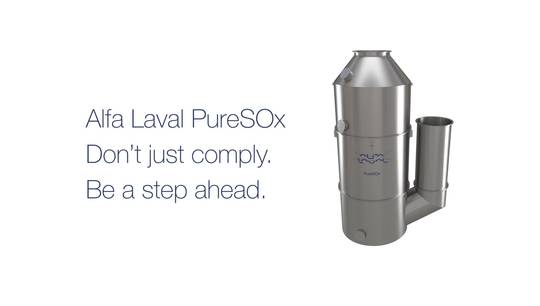
We've been installing the first Alfa Laval scrubbers in 2014.
We are very happy of a number of scrubber providers,
and Alfa Laval in particular,
has a very high reliability standard.
Scrubbers can be improved.
Not only the size, but on what they block in the emission.
Not only sulfur but maybe particulates,
black carbon and more.
Something that is quite funny:
{\an2}The water that we discharge is cleaner
{\an2}than the water that we take.
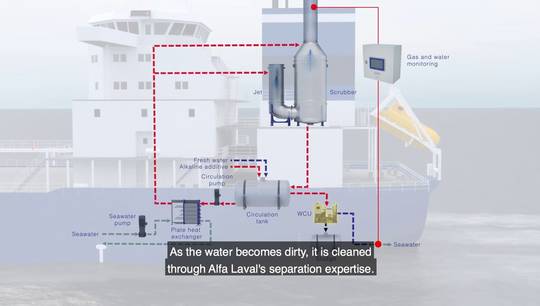
{\an2}because you have a lot of filters into the system,
{\an2}and when you take water in the ports for example,
{\an2}it's very dirty, unfortunately,
{\an2}so maybe in the future the scrubber can clean the water of the port.
{\an2}No, I'm joking!
{\an2}Our dream is to make the scrubber of tomorrow
{\an2}the new collector of microplastics.
{\an2}Because they are the only system that take a large amount of water
{\an2}up to 3,000 cubic meters/hour,
{\an2}you can suck a lake in very few hours.
{\an2}And we are studying with a university and others around Europe,
{\an2}the potentional solution for the scrubber
{\an2}to become, with the proper filters,
{\an2}the collectors of plastic in the sea.